
Introduction: The Origin of BioAI Species
In 1859, Charles Darwin revolutionised our understanding of life with his theory of evolution by natural selection, a framework he built entirely from years of meticulous observation, synthesis and collaboration with fellow naturalists.
As the life sciences advanced, biology fragmented into ever more specialised disciplines from molecular biology to genomics to systems biology each decoding slivers of life’s vast complexity. Today, the scale and speed of biological data far outstrip the capacity of the human mind to make sense of it.
A new revolution is underway driven by machines that can recognise patterns far beyond what Darwin’s or any human brain, could ever grasp. AI is emerging as a force that will reshape biology, medicine, and ultimately, the limits of human life.
If the 20th century was defined by physics and information, the 21st century belongs to biology. And AI is fundamentally rewriting this story.
AI in Biotech – Molecule Makers
Biotechnology has emerged as a discipline manipulating life’s building blocks through laborious lab work and incremental discoveries. Today, AI is transforming this paradigm, enabling rapid design and simulation that accelerates early-stage research and expands the frontier of scientific possibility.
1. Protein Folding: Cracking Biology’s Greatest Code
For decades, predicting a protein’s three-dimensional structure from its amino acid sequence was one of biology’s grand challenges. Experimental methods took months to years per protein, costing hundreds of thousands of dollars each time.
In 2021, DeepMind’s AlphaFold released high-confidence structures for over 200 million proteins—an advance estimated to have saved $1.2 billion in experimental costs and over 500 years of cumulative lab time. Shortly after, the Baker Lab’s RoseTTAFold offered a lighter, more accessible alternative for academic labs.
In practice, researchers tackling malaria, antibiotic resistance, or neurodegeneration can now start projects with high-confidence 3D models, saving months of work and unlocking targets previously considered experimentally inaccessible.
While no approved drug relies solely on AI-predicted structures, pharmaceutical companies are using these models to prioritise viable targets, reporting 30–50% reductions in target validation timelines, a significant efficiency gain in a high-cost industry.
What once took a year and $100,000 can now be done in seconds, for free. More than a research tool, protein structure prediction is becoming an innovation asset unlocking previously inaccessible drugs, accelerating discovery, and reshaping pharma’s early-stage R&D.
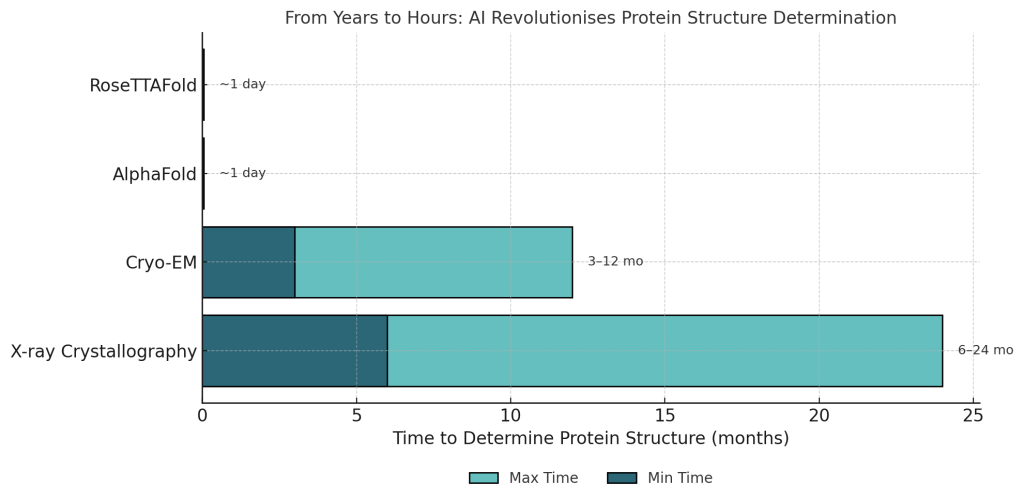
AI has reduced protein structure prediction from months or years to under a day. Sources: Nature (2021), Science (2021), DeepMind, Baker Lab; typical timelines based on experimental averages for X-ray crystallography and cryo-EM; AI durations based on AlphaFold and RoseTTAFold benchmarks across published protein datasets.
2. Generative AI for Drug Discovery: Creating Novel Molecules
If protein folding AI helps us understand biology’s existing machinery, generative AI enables the design of entirely new molecules to modulate it. Traditionally, early drug discovery has <0.01% success rates, with average development costs reaching $1–2 billion per approved drug.
Generative AI offers three fundamental shifts:
Speed – models now generate potential drug candidates in hours, not months.
Exploration – they navigate billions of molecular structures beyond human intuition.
Design – they produce entirely new proteins, peptides, and enzymes with desired functions.
Does the promise meet reality?
Morgan Stanley projects up to 50 AI-enabled drugs could enter the market globally over the next decade. Based on current pipelines, it is realistic to expect 5–10 approvals by 2035, with the first likely within the next 2–3 years. This marks the emergence of AI-generated molecules as a new modality in drug development and a step toward self-generating biomedical innovation.
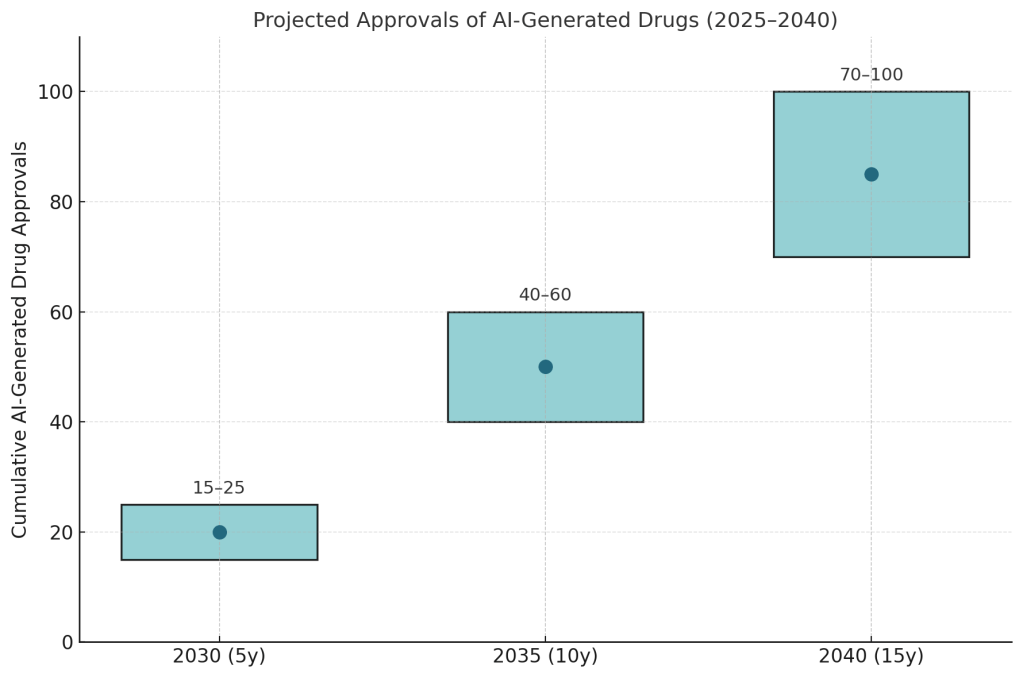
Estimated approvals of AI-designed drugs globally over the next 15 years. Midpoint dots indicate central projections, with ranges reflecting uncertainty across sources. Based on WHO pipeline reviews, Morgan Stanley’s 2035 forecast (~50 approvals), and extrapolation of current clinical momentum. Sources: WHO (2023); Morgan Stanley (2022); Internal projections (2024)
AI in Healthcare – Optimising the Human System
While AI-driven biotech accelerates medicine creation, AI in healthcare transforms care delivery within one of humanity’s most complex systems. Driven by maturing technology and growing data availability, AI’s impact is visible across three core domains: Diagnostics, Prediction & Prevention, and Operational Optimisation.
Diagnostics: From Scarcity to Scalable Expertise
Healthcare faces a growing diagnostic bottleneck as the WHO projects a worldwide shortfall of over 900,000 radiologists and pathologists by 2030.
AI addresses this scarcity directly. In radiology, pathology, and microbiology, diagnostic AI models now routinely match or exceed specialist accuracy—achieving equal or superior outcomes in over 85% of imaging studies according to a 2022 Lancet Digital Health review. Crucially, AI delivers unmatched consistency: it doesn’t fatigue, forget, or fluctuate.
The potential human impact is profound, as diagnostic errors currently cause 10–15% of adverse healthcare outcomes, affecting millions annually. With over 3 billion people globally lacking basic diagnostic access, AI could democratise life-saving expertise.
Economically, McKinsey estimates AI will boost imaging productivity by 20–40%, propelling the medical imaging AI market toward $10–20 billion by 2033 (30% CAGR). The key remaining challenge, clinician trust and confidence in deploying specific AI models—will be explored in greater depth in the future.
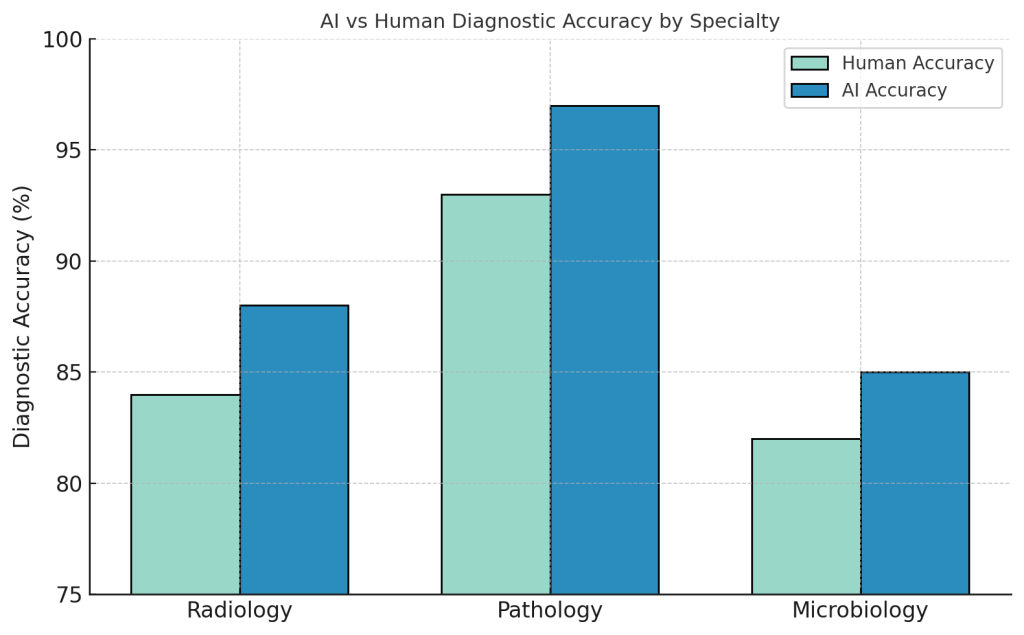
Comparison of average diagnostic accuracy between AI systems and human clinicians across radiology, pathology, and microbiology.Values represent mean estimates from peer-reviewed evaluations and clinical benchmarks. Sources: Lancet Digital Health (2022); Nature Reviews (2023); McKinsey HealthTech Insights (2023)
Prediction & Prevention: The Holy Grail of Healthcare
Healthcare has traditionally been a reactive system addressing disease only after symptoms appear. Predictive AI is changing this, identifying risks early and enabling targeted interventions before illness takes hold.
Already, predictive models from MIT and Mass General forecast breast cancer up to five years in advance, outperforming traditional screening across diverse populations. In the UK, predictive AI anticipates COPD flare-ups days in advance, reducing emergency admissions by over 20% and profoundly enhancing patient quality of life.
The economic potential is enormous. Predictive AI could save the U.S. healthcare system $200–360 billion annually by preventing hospitalizations and complications. In Europe, PwC projects savings of €74 billion on breast cancer care alone and €90 billion through childhood obesity prevention over ten years. But achieving this future won’t be easy. It requires systemic change: realigning incentives, embedding AI into clinical workflows, and building trusted data governance. We’ll explore how systems can turn this future into reality in upcoming articles.
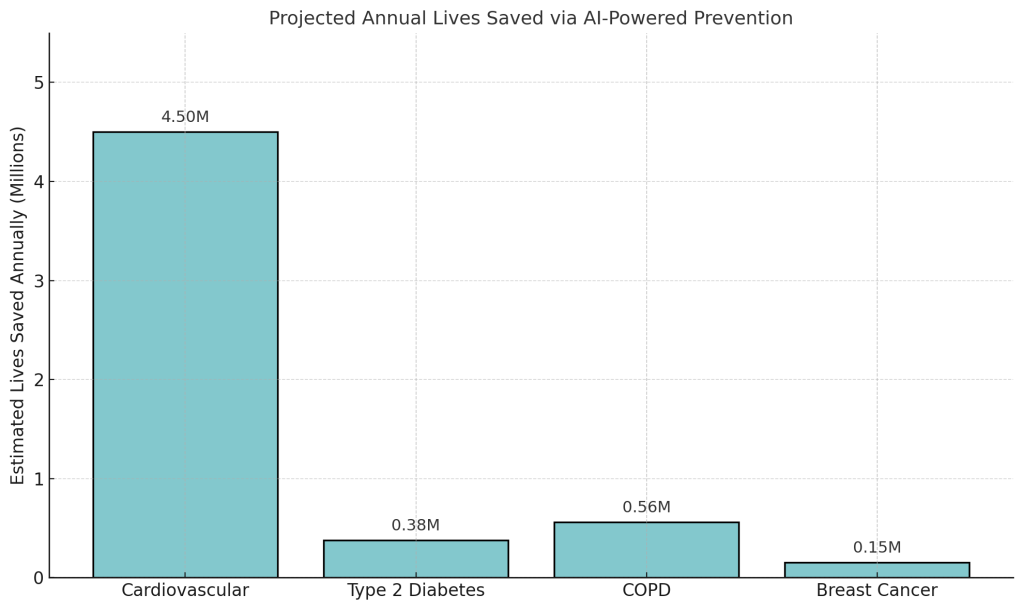
Estimated number of lives that could be saved each year through personalized prevention in major chronic diseases. Values are based on published global mortality data and conservative estimates of preventable deaths through early detection, risk stratification, and intervention. Sources: WHO (2023); McKinsey; BCRF; NHS; Nature; JAMA; STAT
Operational AI: The Unsung Hero of Healthtech
While predictive and diagnostic AI grab headlines, operational AI has delivered the most immediate returns in healthcare. In the UK, NHS trusts using AI for staff scheduling have reduced agency costs by 10–15%, saving millions while improving staff satisfaction with fairer shift allocations.
A recent BCG and World Economic Forum report estimated AI-driven operational improvements could reduce global healthcare costs by up to 10%, translating to hundreds of billions in annual savings through productivity gains, improved capacity planning, and reduced patient delays.
The Future of AI x Biotech x Health
The true promise of AI in life sciences lies in its convergence into an intelligent, integrated health ecosystem. Imagine a future where generative AI designs therapies tailored to your physiology, predictive systems forecast disease decades before symptoms emerge, and proactive interventions arrive seamlessly at your doorstep. Each of these capabilities exists today and the next frontier lies in combining them into a unified system.
Finally we’d like to make a few predictions to where this is all heading:
By 2035, AI-driven drug discovery will cut development timelines by 30–50%, accelerating breakthroughs in cancer, Alzheimer’s, and rare diseases. Personalised interventions in Europe alone will save millions of lives, adding 2–4 healthy years per person by 2040. And whole-population screening via retinal scans, ECGs, or voice will become routine, enabling early detection of heart disease and cancer years before they manifest.
The long-term vision is even more radical. By the end of the century, AI and biotech could extend human lifespan to 150 years, as precision medicine becomes the global standard. Major chronic disease-killers like cancer, cardiovascular disease, and dementia could even become things of the past, fundamentally reshaping how we age and live.
But convergence is not guaranteed. Data silos, regulatory fragmentation, and misaligned incentives remain formidable obstacles, especially in regions with complex regulation like the EU. Those who build and govern this new architecture will redefine how long and how well we live. Turning this vision into reality may be one of the greatest responsibilities of our century.
Sources:
WHO, DeepMind, Baker Lab, Morgan Stanley, McKinsey & Company, BCG & World Economic Forum, Lancet Digital Health, Nature Reviews, JAMA, PwC, NHS, BCRF, STAT.
 NovastrA
Leave a comment